Featured Blog Content:

Be Strategy Focused Rather Than Outcome Focussed

 Do people still read blogs?

I've neglected this one for far too long between updates. There's a lot of good stuff from years gone by that you may recall, or you might want to catch up on.

Something I've always spent a lot of time thinking about, writing about, and talking about, is less the specifics of training and exercise, and more the sort of outlook and attitude that you want to come in with, if you really want to enjoy permanent and ongoing success.

So, if you want my advice on that topic, after 12 or 13 odd years or however long it is I've been in the game as a professional coach, here it is;


"Goal orientated" was definitely a buzzword you wanted to have in your cover letter when job hunting back in the 90s. Now though, and with fitness goals in mind... not so much.

Feels like an odd thing to say, come to think of it. "With fitness goals, be less goal orientated". But if you really think about it, it does make sense. Think less about the goal, and more about the strategy that might take you towards that goal.

 Typically in fitness people will have a goal, or will be asked what their goal is. 

Usually in the past that would be a weight related goal. I want to get down to this weight, I want to lose this much weight, and so on. Usually inspired by what you imagine you might look like at that weight, or how you imagine you might feel about yourself at that weight.

That's often the next question in a fitness consultation, after "what is your goal?".
It's "and how would you feel once you have achieved that goal?". Maybe this all sounds familiar to you already.

But let's assume for now this is just a conversation you're having with yourself or with a friend, not with someone trying to sell you a gym membership or whatever.

I'm going to lose this much weight, and I'm going to look like this, and I'm going to feel like this.

OK great. But how?

Usually the "how" is where people fall down. 

Well uhh... I dunno I guess I'll stop eating bread. Or I'll do the cabbage soup diet again.

Something like that, right? They're just clutching at straws.

Often in a consultation with someone trying to sell you a gym membership or a personal training contract, it's little different.

What's your goal?
Well, I want to lose weight.
OK great. How will feel once you reach that goal?
Uhh... good, I guess?
Awesome. Here's your meal plan. Don't eat anything that's on the naughty list.

In either example, you have a goal outcome, you have motivation, and you have a course of action.

But is there actually a reason to assume that adhering to this course of action will take you to that goal outcome? Is there a reason to assume that this a workable strategy, that you can be expected to adhere to, whether it would even work or not?

Usually no. 

Some of my earliest memories from around the time I got started in this business, were of other trainers asking for advice because for example "I've just taken on my first client and she needs to lose 30kg", and then supposedly more experienced people giving them a list of foods the client needs to be banned from eating, or a meal plan she needed to follow.

I would always ask questions and usually the answers were "she will lose the weight because these are all healthy foods", and "why wouldn't she like the foods? It's all nice recipes. In any case she just needs to want it bad enough to eat clean and prove that she has discipline".

Sadly that's how a lot of people charging money for advice still think, and it's what a lot of people who are paying for advice except to hear, as well.

But it's not "a strategy", is it? It's not meaningful, workable advice that we could logically expect to produce the desired outcome. 

So, what would be a better strategy?

First let's start with a better goal. 

Appearance and condition related goals can be fine, but usually a generic "weight loss" goal or for that matter a more specific "goal weight" goal are ill advised, for reasons I've covered at length on the blog already several years ago.

A better goal might be "get into stronger and healthier shape through training, and a better version of that goal would be "to enjoy getting into stronger and healthier shape through training".

In pursuit of that goal, you focus on the strategy. 

For example as follows:

  • I know I can train 3 times per week every week, and 4 or even 5 times per week on a really good week.
  • Therefore here's a 3 day split training program I will work to every week.
  • I will eat meals and snacks at these times of the day as best suits my schedule around work and training and other responsibilities.
  • Here are the estimated energy and macronutrient intakes required to make progress at training.

As has been very often described here and on my social media channels, the nutrition strategy should be about more than just deprivation, or about "being in caloric deficit". It should be about eating habits that are consistent, sustainable, and appropriate.

If you attempt to over restrict, you're unlikely to be able to sustain it for long. At best, you can kinda stick to the "caloric deficit" but you feel like you're dragging ass all through your training sessions, not really enjoying it, not really seeing progress, and you're not exactly a barrel of laughs the rest of the day, either.

When you're well fueled according to your actual requirements... that's when you're full of energy to train hard, make progress in your performance, add lean mass, see changes in physical condition, AND feel like you're having a good time, more of the time, in general.

Now... a lot of people reading this might still be thinking "well that's fine in theory but I really do have a lot of weight that I need to lose". In which case... again, focus on the process of establishing those consistent training habits, establishing those regular meal times and hitting consistently appropriate intakes, and also put the focus on enjoying training and enjoying life.

Under normal circumstances a heavier person would expect to get less heavy as they get healthier and stronger. A less heavy person is better off being less concerned with weight at all and more interested in just the "healthier and stronger" aspect, and they'll likely find they soon have a healthier relationship with body image as well.

With the focus on the process and the strategy, you don't end up in the same old depressing situation of thinking like "well I was supposed to lose 10kg and I've only lost 3kg and I'm not even having a good time so what's the point of it all anyway?" again and again.

Share:

Starvation Mode. Real or myth?


It's a bit of a tricky question honestly.

Do you ever see these social media posts from fitness influencer types going "oh ho ho ho, starvation mode isn't real! Let's not be silly! Here's what's really going on..." and then they go on to explain and describe... uhh... pretty much what you thought starvation mode was to begin with, am I right?

Here's the thing. 

For a while starvation mode was a hypothesis for which there wasn't a lot of clinical evidence. Therefore many self professed "evidence based" fitness types rejected it outright, regardless of anyone else's personal experiences or observations. Because "that's just anecdotal".

Over the past few years though, we've started to understand a little more about Adaptive Thermogenesis, about the Constrained Model Of Energy Expenditure, and so on.

So... you'll see a few posts out there these days explaining "Starvation mode isn't a real thing that exists, but Adaptive Thermogenesis is", but from your perspective there's no fucking difference between one and the other. These people just don't want to own up to having put out shit content and shit advice for years. That's my take.

What IS Adaptive Thermogenesis, though?


First... humour me for a moment and imagine the following.

You haven't really exercised in a few years. You sign up for group fitness or you buy a home workout DVD or whatever. 15 minutes in... you're out of breath, heart pounding through your chest, sweaty, and feeling a little faint from low blood sugar.

Easy to imagine, right? Possibly something you've experienced.

You keep doing this workout 3x per week though and before long, you can make it through the whole thing and you actually enjoy it rather than feeling like you might puke, pass out, or die.

That's kinda what "getting fit" is.
At first, you're not terribly fit and it takes a LOT of oxygen and energy to get through a little of that workout.
But after a while... not so much.

As you get used it, you can perform the same amount of activity with less energy expenditure.

A reasonably acceptable hypothesis, right? The amount of energy expenditure required to perform a certain activity is not a fixed amount.

OK so let's continue.

One of the things that we now understand a little bit better about maintaining weight loss is... it's harder when you have a lower percentage of fat free mass than when you have a higher percentage of fat free mass. We also know that significant weight regain is more likely when energy intake has been low, compared to when "energy flux" is high. AKA high energy in, high energy expenditure. We also know that beyond a certain level, more activity does not equate to higher energy expenditure.

There are various mechanisms at play here but like we talked about and agreed upon above, energy expenditure is variable. So when you participate in exercise and activity while restricting to insufficient levels of intake, what you're training the body to do is to get better at performing that activity with that amount of energy to draw upon, and eventually to do it while drawing less and less from what is available.

But, you're training the body to cope with that level of exercise. Not so much to benefit from it.

Theoretically if you "eat less calories than you burn", you should lose weight. 

In practice that may happen to begin with, but rather than drawing more energy from fat stores to make up the shortfall, the body starts to conserve energy instead. Rather than a reduction in body weight, you have a reduction in Resting Metabolic Rate. You have a reduction in the Thermal Effect of Food (aka the energy cost of digesting and metabolising food) as you're not eating much of it, and the energy that you would otherwise be expending at training is simply absent and unavailable, so your workouts kinda suck, you don't make consistent improvements in performance like you otherwise might, your enthusiasm runs out out sooner, you start to cut your sessions shorter, and you're less likely to be energetic and active throughout the rest of the day as well. 

This Non Exercise Activity Thermogenesis is likely to be the biggest loss of expenditure to compensate for starvation... and I'd simply describe it as... you know, the difference between kinda dragging your feet doing what you have to do throughout the day, or having a bit of an extra spring in your step as you move around, dancing around a little bit as you're doing the housework, maybe feeling more inclined to do a little extra outside in the garden as well... vs just being fucken knackered all the time lacking the will to get up off the couch. Don't get me wrong though, I love my couch too and couch time is also valuable.

While you're over exercising and underfueling, what you're also doing is NOT making energy and resources available to add to your muscle and bone mass, which as we discussed earlier is what sets you up for greater weight gain when you run out of enthusiasm and gravitate back towards more sedentary habits.

So... call it what you want.
"Adaptive Thermogenesis" is the more scientifically valid term but it's pretty much the same difference.
What it does NOT mean though is "if you're late for a meal you go into starvation mode and get fat" sort of thing as you might have read at some point in time somewhere else.

How "Calories In / Calories Out" works is... if your energy intake is in EXCESS of your requirements, you get fatter. If your energy intake is IN DEFICIT (aka you take in less than you burn) you'd expect to lose weight, but if you're too severely underfueled for too long, your body reduces expenditure to compensate. It's a seemingly paradoxical situation of "no longer being in deficit due to insufficient energy provision, and needing to increase energy intake to get back into deficit by giving the body relief from the need to compensate and conserve expenditure".

For results we want to be fueled at a BENEFICIAL level where the body has the luxury of taking up all that we put in, and putting it all to good use in improving performance, replenishing glycogen stores, adding muscle mass, and improving bone density. Obviously to also see fat loss this needs to be short of the point of excess... but we want to train the body to productively utilise MORE and more fuel via foods, so as we become more proficient at exercise, as we progress to more challenging choices of exercise, more demanding training routines, and from performing at beginner level to intermediate level training enthusiasts, that point of excess gets higher and higher.

Share:

How To Easily Remove Rust And Restore Old Gym Gear


So, who'd have known that starting a garage gym on a coastal property would mean rust problems?

If you're starting your own training space at home with some previously neglected gear, or you already have some stuff that is starting show signs of age with a little (or a lot of) surface rust creeping in... well, it's actually surprisingly easy to remove rust and restore old gym gear to it's former condition and give it a new lease on life.

My gym is mix of stuff that I bought new, stuff that I bought used but in good condition, stuff that I bought used and in rough condition further inland before I moved, and stuff that I bought used and in rough condition locally.

Predictably the stuff that I bought locally has been the hardest hit. Even the stuff I bought and scrubbed up before moving hasn't really needed a second treatment.  Take a look at these before and afters of my smith machine, leg press, and weight tree and then I'll tell you how I did it.

Not bad eh?


OK here's the process:

  1. Pour some cleaning vinegar into a bowl or bucket.
    "Cleaning vinegar" is not distilled like the vinegar you might have on your chips, and it's more acidic. You might find regular vinegar still works but I wouldn't be especially confident.
  2. Soak some paper towel in the vinegar, then wrap around the rust effected piece of gear.
  3. Wrap that in plastic cling wrap. I just used plastic bags for a few things because I'm lazy and frugal.
  4. Leave over night, for about 24 hours.
  5. Pull everything off and most of the rust will be gone. Give any remaining rusty areas a good rub with the gross and soggy paper towels as you pull it off, and that will take care of most of it.
  6. In more severe cases you might need to apply a little effort with some steel wool, a wire brush, or emery paper at this point.
  7. Wipe it all dry with a clean rag.
What you'll find though is that a little bit of the rust will start to come back within a few days, especially if you don't remove any trace of vinegar.

Therefore, repeat the whole process with a citric acid solution. You can get citric acid from the baking aisle of your supermarket. Experiment with different strengths but I find about 5 teaspoons to a liter of water seems to do the job quite well.

Do that, and as you can see in the picture of my leg press, some long suffering old gear will shine like new again.

Caveats:

  • Stuff with knurling that is particularly well used might take a few treatments to really get clean.
  • Do NOT use the vinegar on anything with a powder coating, as it'll take that off along with the rust.
Share:

Just putting it out there; I want to coach a wrestler in strength and nutrition.


That's my dream at this point of my life.

I've done pretty much everything else I wanted to do already. I've been a professional coach for 10 years, which was my dream. I've played guitar on six or... wait is it seven albums now? There's a new one as of last week. I always wanted to semi-retire early to a little place with not too many people, ideally within sight of Wilson's Promontory National Park and put my own private strength gym together on site... and I did that just under two year ago as well.

As a coach I've ... well... I've coached fitness enthusiasts, martial artists, strength athletes, endurance athletes, personal trainers and fitness instructors, nutritionists, dietitians, doctors and other health professionals. Usually what I do is take people OFF restrictive diets that are making them miserable, and I get them on the right track with better training programs and fueling strategies for better results that they can maintain and continue to build upon for life.

But what I have yet to do is coach a pro wrestler.

Which now that I think of it... I used to see a lot of wrestlers at Doherty's Gym while I ran my PT business there. But of course... you know, people are there to train, not to have some PT try to ingratiate himself to them and sell a program, right?

First of all though for the uninitiated, let's clear something up before we continue; yes, it is indeed "all fake".


Here's the thing about that though.
You ever watch an action film with a big fight scene? Also fake.
Maybe a knife fight, or a gun fight. People literally dodging bullets, jumping through the air defying gravity and the laws of physics, CGI effects and what not? Also fake. Maybe you thought light sabers existed though, I don't know.

Actually I just googled "how long does it take to film a fight scene" and the answer seems to be anything from 5 hours to 10 days.

So... ok... rather than that, go out and do it live in one take. No CGI, green screen, or other digital effects, no post production editing, no "cut, go again". Do it live in front of an audience who will quickly devolve into real life versions of the Comic Book Guy from the Simpsons if you botch a few spots. Or if their favourite doesn't win. Or if their favourite wins too often.

Look, if you can suspend your disbelief when a TV show puts a dozen women into a mansion or an island and tells them "the prize you are competing for is the love of this male over here" and all the women immediately decide "I love him so much I will be devastated if he chooses someone else"... or for for that matter when a politician speaks on the news or whatever... then you don't get to FUCKEN judge me for watching wrestling, alright?

That said... as a fan, for every time you're thinking "now THIS is a match I'd show to someone who wanted to know why I like this stuff" there's probably 2 or 3 times when you're thinking "thank GOD I don't have a guest here right now" as well. But you know... it's our thing even though it's a bit silly sometimes and even if (especially in my case) we're way too old for it and should have grown out of it a long time ago. It's ok if other people don't get it. I don't get those "two strangers get married for some reason" shows. God how atrocious. What a time to be alive.

Anyway though. WRESTLING.


Modern era wrestling has some of the best athletic performances in memory. There's been a return of more technical styles with legitimate holds and fluent chain wrestling, and more high flying acrobatic action particularly with the return of the cruiserweight divisions. Hands down the biggest change in recent years is the evolution of the women's wrestling. Which brings us to this article, as I mostly tend to coach women.

Here's the thing about coaching female athletes, in my experience.


They aint eating enough.
Non competitive fitness enthusiasts? They also aint eating enough.
Qualified professionals in fitness, nutrition, or other health vocations? They aint eating enough.
People trying to lose weight? Usually the amount they think they should be eating is also entirely insufficient which is why they tend to end up in a cycle of restriction and excess. Because you can't stick to what's insufficient, and it fucks up both your metabolism AND your relationship with food and eating.

Now... when I started out 10 years ago people didn't really get this stuff.
When I started out, it was "you can't out run a bad diet and if you don't eat clean you can't get results", and some time after that, it was "you just have to be in caloric deficit, and if you're not seeing fat loss you need fewer calories and more activity".

The first of those statements is entirely garbage. The second is kinda sorta on the right track but also garbage.

More recently a few more people are starting catch on and there's a little more of an awareness of the risks of Relative Energy Deficiency in Sport (aka RED-S). So that's nice. The medium to long term consequences of RED-S include amenorrhoea, osteoporosis and osteopenia, usually preceded by binge eating disorders and (not always but far too often) bulimia. They used to refer to this as "the female athlete triad". Honestly, it's starting to become prolific in males as well... especially since this nonsense "fasting" fad caught on over the past couple of years.

Something else that a client explained to me is the conflicting feelings and the sense of guilt over... you know... believing in body positivity and in celebrating size diversity, never wanting any other woman to suffer from poor body image or feel pressured to diet harder to a smaller size, lower weight, or leaner condition... but at the same time having that feeling of "for how much I train and for how little I eat I should be more shredded than this", right?

So... that's in general but let's talk wrestling. Or more specifically let's talk about what I would have in mind when coaching a pro wrestling superstar.


I always think of... I think it was the first season of Tough Enough. It was a long time ago and I've been hit in the head a lot since and also there was that thing with the carbon monoxide poisoning last year so sometimes my recollection of things is a little off... but I feel like it was the first season of Tough Enough, and they had all these legit athletes (aka not just body builders or swimwear models) trying out, and a few saying "my cardio is going to set me apart". Then they get told to run the ropes... and dudes start dropping like flies, puking, the works. All thoroughly mystified and demoralised like "I don't get it, i thought I was so fit from my sport".

So I watch some instagram stories of wrestlers who I follow in training... running the ropes, leapfrog, repeat, repeat, repeat. Fast paced, too. I dunno exactly how much time is spent like that but to my observation that is a cut above and more physically demanding than most forms of athletic training or your standard sort of HIIT drill. You need to account for this on top of the strength training when calculating an energy intake target.

Now... people come in different heights and different sizes. Some will be lean and in athletic shape in a more petite condition and a lower healthy body mass. Others will see leanest and healthiest athletic condition at a higher body mass relative to height. For some being especially lean is not the priority anyway. Either way is fine but we must account for this when calculating an intake target. The more naturally petite athlete probably does not need to (although she may desire to) "bulk" to a higher body mass. More importantly the taller athlete with a natural proclivity towards more muscle density should not be trying to diet down to a low body mass even if that body mass might not be unhealthy for someone else. We need to have this in mind when calculating an energy intake target.

We talked about the "caloric deficit" above.


This theory is mostly true. It doesn't really matter what foods you prefer, so long as your daily energy intake is not excessive, and protein is adequate.

However, and with that said... you do require an adequate total energy intake, and an insufficient one isn't going to cut it. And when you take 4 or 6 serious strength training sessions per week in the gym with some level of proficiency and prowess at the big lifts, and you add wrestling training on top of that, and assuming a taller and more muscular young woman... the potential for "not being in deficit" is fairly unlikely. For a shorter woman with a more petite build... I mean it's not inconceivable but if you take level of activity into account you will still have some quite reasonable numbers to work to.

What the average jabroni trying to pass themselves of as some kind of "macros coach" usually doesn't get is the Constrained Model Of Energy Expenditure. Which means... if you're highly active with some proficiency at productive strength training and attempting to restrict to 1400 calories per day to "stay in deficit"... the reason you might cease to see leaner condition is absolutely not because "1400 is your maintenance and you need to slash further to get back into deficit", but because the body adapts to somehow cope with the workload without expending the energy that it would under normal circumsances. Also refered to as Adaptive Thermogenesis. But when you put more energy in, you're then able to expend more energy. It does not mean "1400 is maintenance and 1600 would be bulking", right?

How most of these chumps out there seem to calculate calorie targets is to choose a too low BMI to begin with, not account for activity at all much less a high AMOUNT or high QUALITY of activity at a high LEVEL of athletic prowess, and then slash 500 calories from that and tell you "you're lying" when the shit doesn't work and ruins your life, am I right?

When fueled more adequately, you're able to expend more energy at training, which means you set new personal bests on your big lifts more regularly. When fueled more adequately, you also expend more energy throughout the day just moving about with a bit more of a spring in your step and in a better mood. When you're more adequately fueled, you're able to recover from and adapt to training with the creation of more lean mass rather than it all coming at the expense of your bone density. Also when you approach this strategically, you build a healthy appetite for higher and more optimal levels of energy provision rather than feeling like you are force feeding yourself... that's the other crucial aspect that I honestly don't think anyone else gets.

The best thing for all people is to get into a productive form of training for enjoyment and with their long term physical and mental health in mind. It is a tragedy that for so many people, what should be one of the best things that adds so much quality and a positive direction to your life becomes the very opposite, because of that "dieting" mentality that we're conditioned towards. In highly active people and especially in athletes with a more advanced level of physical prowess, best physical athletic condition will come with a healthy appetite, a healthy relationship with food and with eating, and while working closer to a more adventurous estimate of the highest energy intake you can benefit from, rather than the most conservative estimate of the lowest energy intake you can struggle to get by on.

Anyway this kind of turned into the same as every other entry I ever wrote on this blog about how over restriction is bad and no one else is as good at macros as I am. But geez how good would it be to work with a pro wrestler towards some really suitably optimal intake targets, see her get happy and strong, do some fun social media stuff, decorate my private gym with some memorabilia, and live vicariously a little from my off grid doomsday compound here at the edge of the Earth?
Share:

Too depressed to eat?

Recently I've had a few conversations with people I know and also happened to see some other discussions on social media about depression and appetite loss. Particularly in more active fitness enthusiasts and serious athletes, this is obviously a serious concern.


First Of All

I want to start out by emphasising that nothing in this entry is intended to come across like "well, you'll just need to eat. Why can't you just eat some of this, there's nothing hard about it" the way you might have been a little apprehensive about. Believe me, I get it. I probably get it better than anyone. When you're depressed, being told "just do it, what's so hard about it?" is the opposite of helpful. While you're at it "just try to cheer up" too, am I right? Ugh.

I know it's simple. I know there's nothing hard about it. I know it's what I need to do. I still can't do it, because my mental health is fucked. You think I don't know all of this and feel even worse about it already?

Like I said. I get it, alright? I have reason to get it.
Also with my history of Avoidant / Restrictive Food Intake Disorder, I get it better than ANYONE that "you'll just have to eat, why can't you just eat it?" is an infuriating attitude to be on the wrong end of.

That said... there might be a few things you could do, which would be better than not doing them.

Our task is to find what those things are.
And always remember... a little bit better is always worth doing if you possibly can. Even if it's still a long way from perfect, a little bit better is a lot better than a little bit worse. It's totally worth doing even if your depression might be trying to tell you otherwise.


Second Of All

I always advise that "there are no bad or unhealthy foods" in the attempt to be adequately nourished vs being under nourished. The same is true in pursuit of more optimal energy intakes on a sports nutrition basis vs falling short of an adequate energy intake. This is why I make a point of doing social media posts where I'm eating a donut, for example. Also it pisses off the pretentious food snobs out there, and that's kind of a hobby of mine.

In this case though... "optimal energy intake on a sports nutrition basis" isn't a luxury we're concerned with. We just want to get somewhere closer to a not insufficient level of energy intake and nourishment.

In this circumstance, any food is better than an absense of food. However... let's be realistic here. If I say "literally all choices are good choices, just get those calories in no matter what" and so you eat three massive bags of chips or something, you might benefit from the energy intake, but you'll likely feel like crap from too much salt, and not enough nutrients, and so on. A small bag might fit into the plan somewhere though if it does take your fancy now that I mentioned it.


So, here are some suggestions... intended to be of the "could you possibly?" variety. 


If you read any of them and kind of sigh to yourself and say "well yeah I could do that. I'm still going to be depressed though and it's still not very good" then... look, just go with the "yeah I could do that" part. It doesn't have to change everything. In fact... that's probably the attitude to have about it; "it's not going to change everything but yeah I'll do it anyway".

So... could you possibly eat 40 grams of mixed nuts per day? How about most days?

I started with the nuts because it's not even a meal. It's like, a handful and a half. Not something you have to spend any time preparing, or even sit down to eat, or clean up after. And the nutrient value is... it's up there, man. There are all manner of long term health benefits associate with regular consumption of nuts. In our case though... energy and nutrients on a daily basis is what we're interested in, and assuming you have no allergies, nuts are a great start. There's actually some evidence that the anti-oxident phytochemicals in nuts can protect against depressive symptoms. I don't want to promise too much about that, but feeling better nourished and feeling a little more positive about having practiced some self care in the form of a nutritious snack... that's better than nothing, right?

Assuming that's a possibility that you can entertain, we would have gone at least some of the way to meeting your energy, nutrient, and fibre needs.


What else would be beneficial though?

Obviously we're interested in protein, fibre, vitamins and minerals, and a not insufficient total energy intake across the course of the day.

In pursuit of this... particularly in more active people... caring about other people's pretentious ideas about what your food choices should look like is counter productive. There's nothing wrong with a big bowl of cereal if that's something you could see yourself having. There's nothing wrong with a protein shake either, and if you can consider blending a banana, some coconut, peanut butter or other high energy density options into it... that'll definitely get you closer to a suitable energy provision for the day.

I always tell my fitness enthusiast clients; "ice cream is a highly beneficial strategic choice" when we're trying to stimulate a little more appetite in pursuit of a more optimal daily intake rather than a merely adequate energy intake. Because feeling like you are force feeding youself is not a lot of fun, but we do consistently find that when you start to get those energy intakes up closer to where they need to be, the human body kind of gets the idea, sparks that appetite response, and lets you know that it could benefit from getting the same amount (or a little more), more regularly.

We do need to keep a little perspective on this, because getting into the habit of over consumption of nutrient sparse foods on a regular basis isn't in our best intersets. But when the situation is that we're active, with little appetite, and not in the habit of eating much or anything at all... however we can work on getting some more regular, more appropriate levels of energy intake is a good thing. Actual meals are more ideal, but they don't have to be fancy or pretentious. Beans on toast, eggs on toast, french toast, hummus & avocado on toast... not very fancy but all highly nourishing options with minimal effort involved. But if none of that is going to happen right now, just stick to what you can make happen until maybe you start to feel like you can do a little more.

The rest is the same as for anyone under normal circumstances, or especially under A/RFID circumstances. If there's a fruit or vegetable that you could imagine yourself enjoying, work on making that happen more regularly. A potato definitely counts, although I always suggest keeping it out of the deep fryer if you can.

Hopefully at this point, you have an idea or two of things you can start to implement.

Even if it still doesn't feel like you have "a healthy diet", and even if it doesn't make whatever other issues you're battling against go away... it's worth doing. If doing it does give you at least one thing to feel a little more positive about, that's great. But if it doesn't, it's still worth doing.

Even if you don't feel like you can quite start to make anything happen right away... just keep this filed away in the back of your mind and one day it'll feel a little more doable.


Addendum:

Listen up though because this is a unique set of circumstances. 

I am writing this with a specific set of circumstances in mind, and in fact I actually have particular individuals in mind who I know to be in these circumstances.

There will be people in other circumstances who for example have just gotten into a bad habit of skipping meals throughout the day, working through lunch, then being ravenous and over eating in the evening. Depression may also play a part in this, but in these cases the best advice is to acknowledge that you need to practice good self care, take your breaks at work, and have some suitable meals across the course of the day.

This is a different circumstance to what is being addressed in this entry and you should not interpret any of this like "this guy Dave says it's ok to skip meals and I can just make up the difference with 3 bowls of ice cream at 9pm because food is food and all food is healthy", alright?

Good self care with reasonable choices of meals and snacks across the course of the day and perhaps just a little serve of ice cream later on is a good plan for most people to aspire to.

Also to any of the creeps who always monitor my content for anything they can possibly complain about like "he's telling depressed people it's ok to eat junk! he should be telling them they need to go on this highly restrictive healthy diet with no carbs or enjoyment instead, or else it's their own fault that they're depressed" just fkn save it man I still don't care what you fucking idiots think.

Share:

The Benefits and The Perils of Intermittent Fasting

I've had a few conversations about IF lately and as you're probably aware... it's not something I usually recommend.

However... if you're someone who's always struggled with your eating habits and a part of the reason for that is something like "I don't like eating breakfast, I don't particularly like breakfast foods, and I don't feel inclined to prepare one of the meals I do like at 5am when I have to be up and ready for work"... you might be very relieved & reassured to learn that you don't actually HAVE TO eat breakfast at all.

Otherwise, that's the start of your problems, right?

You're trying to get it together and adopt healthier eating habits, but it's only 7am and you've already blown it by failing to eat breakfast like you're supposed to. Well, maybe you can try again next Monday since today is already a write-off.

Forget all that. The CONVENIENT TRUTH is... if you don't want to eat anything until noon, that's fine. But you will need to have a substantial lunch that goes a significant way to towards meeting your energy requirements. Individual requirements vary but you probably want to be thinking 600 - 800 calories for that meal alone.

NEGLECTING to eat breakfast and then trying to get by on a LIGHT lunch is probably going to end badly, but PREFERRING to not eat first thing in the morning and having a SUBSTANTIAL lunch instead could be the beginnings of a suitable & sustainable plan towards long term appropriate eating habits and improved health.

The PROBLEM with "Intermittent Fasting" as a concept though is that it is often presented in a manner that suggests that it is admirable, preferable, virtuous and beneficial to go as long as possible without eating, as a vehicle towards eating as little as possible. In other words, as a proto-anorexic, restrictive fad diet. As if we needed one more of those, am I right?

It is helpful to know that it is not necessary to eat on any schedule other than the one that happens to best suit your personal preferences and schedule. However, this is just as true about “time restricted” eating as it is to “traditional” meal schedules, and if you happen to be someone who likes to eat a bowl of cereal, a slice of toast, or whatever other reasonable choice to start your day... there’s little reason if any to feel obliged to attempt to delay eating until later.


So if Intermittent Fasting is a vehicle towards more confident and consistent eating habits to an appropriate total energy and nutrient intake... that’s good! If it’s a vehicle towards restricting to insufficient intakes, and particularly when it presents such disordered eating as a good and virtuous thing that is beneficial to health, then obviously that’s entirely not good. I hear from a lot of people who may or may not have issues around eating to begin with, who report that what started as "Intermittent Fasting" ended in a prolonged and destructive cycle of restriction and binge eating. That's... that's really not something we want to see happening to people.

Context is everything.

Benefits Specific And Exclusive To Intermittent Fasting.

I keep getting told that I obviously have a poor understanding and am ignorant to the benefits of Intermittent Fasting. Well... it does seem unlikely that I’d ever be wrong about anything related to nutrition (it certainly hasn’t happened so far), but I am always happy to learn.

When people have eating habits that are inappropriate in terms of excessive energy intakes, poor protein & micronutrient provisions, OR erratic shifts between insufficient (due to restriction or neglect) and excessive total intakes... going on ANY diet tends to result in improved health markers in the short term due to more structured eating habits of a not excessive energy intake, with or without weight loss. This is true even of highly misguided diets that omit beneficial choices and likely to result in health complications over the long term.
The benefits people report and credit to Intermittent Fasting occur for the same reason, and not due to delayed and time restricted eating. To prove otherwise, you would require one group of people on a time restricted eating protocol, with the same exercise habits, total energy, protein & fibre intakes as another group eating their meals across the course of the day.

I have been asking people to make me aware of any studies of this nature which found a benefit exclusive to fasting that people eating on a more traditional schedule are missing out on... and so far no one has been forthcoming.

Conversely, this study found that autophagic signalling was activated by exercise in both a continuously fed group and a group following a 36 hour fasting protocol. "Autophagy" being one of the main buzzwords being thrown around as a benefit of fasting protocols.


Further, this study on 5:2 style Intermittent Fasting found poorer long term adherence and poorer outcomes over 12 months compared to working to the same energy intakes on a daily basis. Note too that in this study people got to choose whether to trial the fasting or non fasting approach, rather than having it assigned to them.


In any case... as always... the same as when it was paleo, the same as when it was low carb high fat, low carb healthy fat, ketogenic, and so on and so on... what’s important is that people work on SUSTAINABLE habits based on their own preferences and requirements. You require enough energy to fuel an active lifestyle, enough protein, enough fibre, vitamins and minerals. There’ll be any number of combinations of meal and snack choices, and any number of meal & snack schedules that will facilitate this... but we’re all individuals and rather than working to someone else’s arbitrary set of rules, we need to PRACTICE working to our individual requirements with our individual preferences, on our individual schedules... and we should have the confidence to be able to adjust as necessary whenever our circumstances change.

There have always been fad diets and people who’ve been sucked in by them insisting it has to be done “this specific way” for reasons other than “more consistently adequate but not excessive energy with adequate protein, fibre & micros”, but they have always been wrong, and they’ll always be wrong.
Share:

OK, But Did You Really Ever Feel Like You Were In Your Comfort Zone?

I've had the idea for this graphic in mind for a little while now, and I finally got around to making it the other day. Shortly after, I realised I'd covered this topic about a half dozen times on facebook over the years already.

I suppose the reason for that is that so much of what goes around on social media seems to be on rotation, whether by the same people or new people. Therefore, if you do an image search on "comfort zone", you'll see a bunch of similar images. Similar to each other, that is. Mine is different.

You know the images I'm thinking of, right?
"Here's your comfort zone, now here's where all the magic happens"... variations on that theme. Nothing happens without stepping outside your comfort zone, apparently.

I don't think that's quite right.
For one thing, I don't think people are comfortable to begin with.
For another thing, a lot of these graphics suggest there's "your comfort zone" and then there's "outside the comfort zone" which is where good things happen. For a lot of people, that sounds more like "the panic zone", am I right?

Anyway check out my improved version below.


Like I touched on earlier... it seems to me that a lot of people are confusing "the comfort zone" for something more like "the stagnation zone". When you're frustrated and you feel like you're not getting anywhere and something needs to change... that's not comfort, right?

So, we're actually more comfortable doing something than doing nothing.
But we also do have a quite sensible level of apprehension about feeling overwhelmed and out of our depth, which is what often does keep us stagnant. To my way of thinking, this is why the suggestion that you need to get out of your comfort zone doesn't help.

What I'm trying to suggest is that there's a lot of productive middle ground between doing nothing, and being stressed out trying to do everything all at once, before you're ready for it.

So, your comfort zone actually is doing something.

The progress zone is doing something a little more meaningful, a little more consistently.

In my graphic, I deliberately tried to suggest that it’s a bit of blur and the comfort & progress zones kind of overlap, but to keep making progress you want to get comfortable with doing more, and do more of what you're comfortable with.

What I suggest here though is, if you aint pushing forward, you're going to slip backward. Always be looking to be comfortable with pushing further into the progress zone. What I've attempted to describe before is standing right in the middle of that zone, taking a step forward to do what it takes to make further progress, and then the whole bubble shifts with you so that that's now where you're comfortable, until it's time to take another step forward.

What you'll also notice is a strong barrier between the progress zone and the danger zone. This is for two reasons;

One, you don’t need to do more than you’re comfortable with before you’re comfortable with it.
Two, for a lot of us sometimes once we’re started we need to exercise a little restraint before we start pushing too hard and risk burning out. Especially if we have a history of taking a good thing like pursuing an interest in exercise and practicing mindful eating habits, and taking that to a destructive extreme.
Share:

Specific Goals Require Specific Approaches

More specific goals require more specific actions, approaches, and strategies.

What most people want is some variation on the theme of get stronger, build muscle, lose fat, enjoy what you're doing and feel good about yourself.

That's a fine goal well worth pursuing. But it is actually quite a generic goal. Any decent strength based program with enough of the good stuff will take you a long way towards it. Even a merely half-decent program will take you a long way compared to being inactive.

CONSISTENCY matters though.

If you consistently train from 4 to 6 times per week, you can expect more consistent progress, and to progress further in less time. You'll have a higher energy requirement and more margin for variance as well.

If you intend to train 4 times a week but more often only make it a couple of times... you can't expect the same level or consistency of progress, or to have as high an energy requirement or margin for variance.

So... my observations:

1. People often want to produce a drastic change in condition and appearance without wanting to commit to the intention of turning up consistently enough, &/or working to a suitable strategy. AKA "here's what I want to do and how often I'm prepared to do it, but I won't even do that unless you promise me I'll lose this amount of weight within this amount of time".

In which case... life's not like that.

You need to decide that you're going to do what it actually takes, as often as it actually takes. Otherwise go find someone else who's desperate enough for your money to put up with your shit, you get me?

2. People sometimes have the INTENTION of doing what it takes as often as it takes, but for various reasons it doesn't just doesn't pan out that they're quite so consistent quite so often.

In which case... life's like that sometimes.

Even if you're not quite able to see those changes in condition and appearance, showing up when you can is still of benefit, and is still setting you up for the best chance of good health and a good quality of life as you get older.

Therefore it's better to feel good about what you are doing than to beat yourself up for not doing more. Otherwise you only end up doing less, am I right?

That said though... don't be one of these people who wants and sulks about not being able to have the outcome, when the only thing stopping them is that they simply refuse to adopt the strategy and work consistently towards it.

Share:

Appropriate Total Calories is STILL the most important thing.

Nothing is more important than "Appropriate Total Calories".

Or more accurately, "Appropriate Total Calories With Adequate Protein".

Often and to this day you'll still see people suggesting or even insisting otherwise. It's not calories, it's food quality. It's paleo vs processed. It's inflammation, alkaline pH, whatever else.

Nonsense.

It is Appropriate Total Calories first and foremost.

Very simple logic:
  • The appropriate & required amount of energy intake from whatever choices of foods is going to facilitate better performance and produce better condition than one quarter of that amount.
    That's obvious, surely?
  • The appropriate & required amount of energy intake from whatever choices of foods is going to facilitate better improvements in condition than twice that amount, if you're NOT deliberately "bulking" and deluding yourself that that's an improvement in condition.
    Again that's obvious, surely?
So you could argue that "2000 calories of these foods will not produce the same result as 2000 calories of those foods", but it'd be a hell of a lot more similar than 2000 calories of anything vs 1000 or 3000 calories of anything else. Right?

Now though.

WITHIN that total energy intake, you can make wise strategic choices in the interests of not being deficient in required nutrients, and perhaps also increased Thermal Effect Of Food via higher protein and fibre.

You should also consider any choice that facilitates good & enjoyable, prolonged adherence to the program a wise strategic choice. If that's a chocolate biscuit at supper time so be it.

If total calories are optimal relevant to requirements (or at least, somewhere within an "adequate but not excessive" range), protein is adequate to optimal, fiber is sufficient... if you're including cereal grains, vegetables, fruits, nuts &/or legumes you're likely not deficient in any micronutrients and you therefore have a healthful diet that will facilitate good performance and condition as an adaptation to a good training program.

Of what else there is that people talk about as being "as or more important"... it varies from complete nonsense (paleo, alkalinity, and so on) to stuff that may matter but is impractical to attempt to micromanage, and is likely an unproductive distraction from what is more practical and more productive to focus upon, as described above.
Share:

One diet is as good or as bad as any other.


All things being equal people should see similar if not identical results from any diet.

By "all things" we mean total cals, protein, fibre, and not deficient in any nutrients. If those are matched the results are similar.
  • Over the short term people often lose weight on approaches based on exclusion of food types rather than a focus on total calories or macro targets, but
  • It's usually more a drop in water retention than fat loss, and
  • Repeated attempts at diets which restrict to or result in insufficient calorie intake eventually become ineffectual even in the short term, and
  • Most people who do this stuff remain on a long term trajectory of greater weight gain, poorer relationship with & confidence around eating, with the likelihood of poorer long term health outcomes as well.

Vocal advocates of various dietary tribes on social media often boast of miraculous (and therefore dubious) initial results on various approaches, but... where are all the people from five years ago who should be telling us "see, I've stuck with paleo all this time and it has not steered me wrong". There seems to be very very few of them. Even the ones making their fortune from selling the idea seem to have migrated a few times to increasingly more restrictive diets over the years.

But I digress.

All things being equal, one choice of diet should be as effective as any other IF you can stick to it.

People have good initial results because they adhere well to the diet, because they have decided to believe there is a very good reason why this is the superior choice of diet. Often also they have decided that it makes them smarter and more virtuous than all the unclean masses still eating the foods they've sworn off too.

I wouldn't be so unkind as to suggest they're also people with a poor sense of individuality who's self esteem comes from fitting in well with a tribe rather than with appreciating their own identity and positive attributes.

Long term, they still end up fucked.
Arguably, more fucked than if they'd never dieted to begin with.

So. Is there an answer?
Yes.
  • Adequate but not excessive total calories.
    Not so high that you replenish or add to whatever energy you have in fat stores, but not so little that your body slows down, conserves energy and prioritises fat stores.
  • From more of the foods that you enjoy and would have eaten anyway, plus some of the foods you make the effort to include for the sake of a balanced, inclusive, nutrient sound diet.
The reasons to believe this is the right approach are self explanatory. Anyone sustaining long term success in adhere to any set of eating habits that maintains an improved body condition is doing this, regardless of what it happens to look like or what label they slap on it.

They have an adequate but not excessive energy intake from the approach they believe is the best, or at least the best they can do.

YOUR reasons could also include the rejection of harmful diet culture, rejection of social conditioning and peer pressure to "be on a diet", and to live and feel the way you'd hope anyone you cared about would live and feel.

That's what I think anyway.
Share:

Have You Destroyed Your Metabolism With Restrictive Dieting?

This is the most common concern I hear from women when I do a consultation. They're on low calories, not really getting anywhere. Have had short lived success on even fewer calories on other programs before, but found it was unsustainable, made them miserable, and backfired long term leaving them in a state where they needed to continue to restrict just maintain a less lean condition that they started with.

BUT... when they've tried to entertain this notion of "eat more to weigh less" they just found that the scales started creeping up a little, panicked, and went back to what they were doing before.

Sounds familiar?

Here's the thing about eating more:

Food has weight of it's own.

Therefore... when you eat more, you might find that the scales tell you that you've gained weight, but really you haven't. You just have the weight of more food passing through the digestive system. Obviously we're talking about a few hundred grams or maybe a kg here and not several kilos. In people with a higher body fat percentage you also get much wider fluctuations in fluid retention which you wouldn't be aware of if you weren't in the habit of weighing yourself.

So... in the event that you happen to weigh in on a day when you're at the lightest end of the range that you fluctuate within, and then a week and a half later you happen to weigh in on a day that you're at the heaviest end of the range that you fluctuate within... that can be very confusing and misleading too.

So... you eat more food, and the weight of that food might be reflected on the scales. The energy sourced from that food (up to a certain point, anyway) is still of benefit to you. The energy sourced from carbohydrates is referred to as GLYCOGEN and this goes to the muscles to be used to power your next training session. If I remember this correctly from my text books, 1 gram of glycogen comes with 3 grams of water.

If that sounds like a bad thing, it isn't.

So what can happen is that you eat more, feel like you can train harder, feel a better over all sense of general well being... but the scale does not move at all in either direction. In this case... you'd expect at least the weight of the food, right? To my way of thinking in this case you've lost at least an equal amount of weight from body fat as you've added via "volume of food" and what has been made available to be stored as glycogen in the liver and muscles.

This is why you'll often have the experience where people's weight has not changed, but their body measurements, pants size or whatever else have decreased quite significantly. Energy is being stored in the muscles, put to good use at training, then replenished. A similar amount is being pulled from fat stores (likely for Non Exercise Activity Thermogenesis) and not being replenished, because the body has better things to do with that energy and the luxury of being able to do so.

Different people are in different circumstances and there's no "one size fits all" answer.

For significantly larger people of a higher body fat percentage who may have been active but are beginners as far as what we might call "actual training" goes... I'd suggest being less concerned with the scales, more concerned with establishing regular and appropriate eating habits as opposed to dieting, and enjoy working on improved proficiency at exercise and appreciating changes in how your clothes fit as your dimensions change.

For those who are quite active and more athletic, but just not as lean as they'd like to be despite attempting to stick to very low calories of... oh... lets say anything below 1500 calories per day... certainly your metabolism has adapted to manage the workload it is accustomed to on the energy provision it is accustomed to... but it is ruined? No.

If you've tentatively tried eating a little more without a change in fortunes, the situation is most likely that you still haven't increased by enough to allow your body to benefit from your efforts at training, rather than merely to cope.

So, ideally what we want is to build an appetite and build the confidence to work towards levels of fueling where we see improvements in performance at training, improvements in condition, and fat loss at a rate that means that you lose more weight from a reduction in body fat than you add from the increased volume of food passing through your digestive system and the weight of glycogen being sent to those muscles to make them look full & firm and capable of explosive power in the gym.

That's ideal, and it's not always so easy to do on a linear basis.

I happen to have a great protocol to facilitate this though.

Cliff note version of how I suggest you consider going about this.

  • Immediate / First Two Weeks: Come from whatever insufficient level of fueling you're at now, to something that's at least adequate.
  • Next Two Weeks: Increase to what should be a more optimal level of intake. You may see the scales creep up a little for reasons described above but try not to let it mess with your head too much.
  • The Following Two Weeks: return to merely adequate fueling, and you should find that you drop whatever "volume of food" weight gained the previous two weeks, and then a little (or ideally a more significant amount) more. 
  • And So On: So far we've only come to a conservative estimate of more optimal intake, but I usually find at this point the system is working well enough and people are feeling good enough that we're confident to try working to a more adventurous estimate of optimal, and so on until we find our true maximal level.
Not many people seem to have much of a grasp of this stuff. Most people will still tell you that when your body adapts to cope with high levels of activity on low levels of caloric intake, the only answer is to add even more activity &/or cut to even fewer calories. You already know that's impossible.


Share:

Big News: I'm relocating to Yanakie, Prom Country, Victoria.

The big news and perhaps the worst kept secret of the past few months is that I'm about to fulfill my life-long dream of retiring (well, more like semi-retiring) to within site of my favourite place in the world for as long as I can remember; Wilson's Promontory National Park.

If you've been following my instagram you might have noticed I took a few trips out that way recently, but only the members of my Perform, Refuel, Recover, Adapt group were in on the secret that I was actually house hunting.

So, once my settlement on the new place happens circa July, I'll be moving in, renovating a little, and most importantly setting up a kick ass private gym for myself, any of my online clients who'd like to come for a visit / vacation, and of course any interested locals will be welcome as well.

So stay tuned and especially on my instagram there'll be a lot more interesting content in the months ahead as I document setting everything up and exploring the area.

For my Online Clients:

There's lots to do and see around the Yanakie, Corner Inlet, Waratah Bay & Wilson's Promontory areas. Mountains to climb, hikes to hike, scenic tours by air or sea... you name it. There are several options of affordable holiday rental accommodation within walking distance of my new place, and I'll also have a guest room for those I'm especially comfortable with. Glamping on my property may also be an option, I'll have to check if there are any council restrictions on that.

For any curious locals:

I've been in the Fitness industry since around 2010, coaching out of the world famous Doherty's Gym in Brunswick as well as with clients from all around Australia and the rest of the world following my online coaching strategies. I'm best known for my innovative approach to sports nutrition, and online activism against restrictive, fad diets and the proliferation of eating disorders amongst fitness enthusiasts.

Jump to my new Personal Training In Yanakie info page for conditions and package details.
Share:

Best Evidence Based Practice vs Best Emotional Intelligence Based Practice


I deliberately made the title a little bit more intriguing for click bait purposes. The reality of the matter is that the best practice IS an evidence based + emotional intelligence based approach.

To the right you can see a little graphic that I whipped up earlier. The first venn diagram is something you might have seen variations upon before, and I had the second diagram in mind to tie together a few of the topics I've covered on facebook in the past.

I had a post a while back about coaching strategies, and how I really think the importance of having a good coaching strategy can't be overlooked. Of course people need an effective training program, they need an appropriate nutrition strategy, but they need more than just that... and as far as I'm concerned it's not just "accountability" either.

What's also important is that people come into a program with some idea of how the training strategy works, some idea of how the nutrition strategy works, and that they're confident and enthusiastic to give it their best try. The coaching strategy in my opinion should be something that builds and increases those levels of confidence, enthusiasm, optimism and ambition, and in my opinion the outlook should be a positive one based on enjoying the challenge.

What should those strategies be based on, though? Refer to the first chart.

This is something else that appears to be often misunderstood.
  • Best Scientific Evidence will support whether something is necessary, beneficial, worthwhile, or otherwise. Note however that just because it might not be necessary to do something in a specific way, this alone is not always a reason not to do it that way. See the following point.
  • Professional Observation & Experience may influence how the coach feels is the best way to approach those necessary & beneficial aspects. For example; "in my experience with my clients, we seem to maintain better enthusiasm, better adherence, and therefore better results and altogether a more positive experience when we go about it this way". For this reason, anecdotal evidence is still valid in discussing what makes for best evidence based practice. For some reason this remains a point of contention.
  • Client's Needs & Goals obviously another crucial point that people seem to overlook. 

This applies to each individual aspect of the coaching strategy, and the coaching strategy as a whole. Otherwise... well, here's a flow chart that I made which I think is pretty cool, too:

Now... we could be talking about weight loss goals, athletic condition goals, whatever goals. And I do seem to write about weight loss a lot lately for a guy who doesn't really think weight is the thing we should be primarily focused on. Either way though, here's the thing; the purpose of these articles isn't to promote weight loss or to sell weight loss or whatever else.

The purpose is to protect people, right?

To protect people from the belief that there's some certain diet that they need to be on to lose weight, some certain choices of foods that they need to avoid or else they'll get fat, some reason they should have been able to stick to some awful dietary regime despite being hungry and miserable... and in specific reference to what is considered "evidence based" in online fitness & coaching cliques, to protect people from the idea that they can reasonably be expected to heavily and indefinitely restrict caloric intake to extreme levels of deficit, or that this would actually be conducive to best condition.

Particularly in the context described above, the term "evidence based" as been so abused over the past few years that is become virtually meaningless. Everyone thinks they're evidence based, no matter how little evidence there actually is that supports their position, no matter how much evidence refuting their position which they dismiss arbitrarily or simply refuse to acknowledge... some seem to think that simply by considering themselves "evidence based" people that they're automatically right about everything despite their total inability to provide a compelling argument in support of their opinion, or an intelligent thought on anything else, either.

Now, when you're talking about weight loss or you are talking about lean athletic condition... here are some facts I don't think you can dispute;
Individuals have been successful via a variety of approaches, but not by just one particular approach to the exclusion of all others.

Despite this, no approach that exists has a good track record of success, especially "long term" success in weight loss without weight regain.
In fact, according to the International Journal Of Obesity; “it is now well established that the more people engage in dieting, the more they gain weight in the long-term.”

So... everyone on social media is an expert on weight loss, but no one (well, relatively few people) is actually losing weight successfully. Everyone seems to want to 'splain what everyone else should be doing, and what every dietitian, nutritionist, GP & other health professional and their respective organisations should be recommending for weight loss.

Here's the thing; if there's no approach that exists with a proven track record of resulting in long term, sustained weight loss... arguing in favour of ANY approach is not being "evidence based" no matter how many times you use the phrase or how many links you drop.

The only argument on the subject that is evidence based is to point out the futility of attempting to force people en masse on to any dietary regime based on restriction, deprivation &/or the omission of any particular food choices.

Any evidence based approach should have a good outcome, but if you scroll back up a little to my beautiful flow chart, you'll see that somewhere in between "evidence based approach" and "best long term outcome" there's some unknown point at which it all breaks down and doesn't quite work out the way it is supposed to.

So, really the discussion isn't "Evidence Based vs Emotional Intelligence" so much as it should be about applying some emotional intelligence to an evidence based approach. Because as per the flow chart above, when you leave the emotional intelligence part out of your coaching strategy, all you're really heading for is a great big question mark.

Any form of intelligence seems to be in short supply amongst humans these days, but emotional intelligence might be the rarest form of all.
Share:

Dieting And Weight Loss; It's Time To Face The Facts

Real talk though; we need to face the facts about dieting for weight loss.

On any specific approach over the long term, more people are unsuccessful than are successful. On all approaches combined, more people are unsuccessful than are successful. However... while successful outcomes are the minority, they are not exclusive to any specific approach.

What can we observe or logically conclude about what enables a person to be successful with any approach to dieting?

I suggest the following:
  • They enjoy & have an appetite for enough of the included choices of food that they are satiated, or at least that hunger levels are manageable.
  • Total energy intake is far enough below "an excessive" level that would preclude fat loss, but high enough to avoid or mitigate adaptive thermogenesis aka "starvation mode" in the common vernacular.
  • Ideally they're including a suitable amount of reasonably healthful and nutritious choices, but some famous "stunt diets" you may have read about prove it could be done on just potatoes, twinkies, macdonalds, ice cream & whey... whatever. None of which I would personally recommend but it demonstrates an important point.
  • The eating habits they adopt fit in with their lifestyle & circumstances, and they're able to stay enthusiastic and not gravitate back towards their old habits.
  • So there are any number of overly simple answers but the reality is that for most people, success is going to be something that you have to decide upon and keep working on, on an ongoing daily, weekly, monthly, seasonal, year in, year out basis. Therefore you want "the path of least resistance" in my opinion.

Now... people often attempt to 'splain to me that their personally prefered diet (usually LCHF) is "more satiating" and therefore preferable over brute force starvation approaches which work in theory but backfire long term due to the effects on metabolism.

You can refer to the above for what is wrong with this logic. It would be satiating IF you happen to enjoy enough of the foods that fit this eating style and happen to consume enough of them to meet that "adequate but not excessive" energy provision that results in weight loss without metabolic adaptation.

However if you DON'T happen to enjoy enough of those foods, then it actually does become a brute force deprivation based approach. I still don't really understand how people can be quite so low in emotional IQ that they can't grasp this concept.

ANYWAY let's wrap this up.

With the right guidance you could achieve that "adequate but not excessive, satisfied but not stuffed, weight loss without metabolic downgrade" eating pattern on ANY selection of foods without feeling afraid or guilty about ANY particular choices or needing to rule anything out (other than on specific medical grounds obviously).

That's what I teach people to do.
Share:

Interrupted / Intermittent Energy Restriction Sports Nutrition Strategy

Brand new for 2018, a new variation on the Flexible Fueling system inspired by the recent MATADOR (Minimising Adaptive Thermogenesis And Deactivating Obesity Rebound) Study showing that greater weight loss results were achieved with a "two weeks on, two weeks off" approach to dieting compared to continuous energy restriction.

I want to try to skim over a couple of things that have been covered previously and get on to what's new. My Flexible Fueling approach (in fact, even before I started calling it Flexible Fueling) has always been about getting people OUT of that restrictive, further and further into deficit approach to IIFYM and getting them confidently enjoying a variety the delicious & nutritious foods that suit & appeal to them, to a total energy provision that is adequate, but not excessive.

Flexible Fueling Towards Intuitive Eating

I covered this in more detail recently, but suffice it to say that for many people it's enough just to get out of dieting, practice regular eating habits to ensure that they meet at least a conservative estimate of their minimum requirements, leaving a reasonable margin for error or variance so that they don't have to feel anxious about a social engagement where they may indulge a little... and to understand that as this is a conservative estimate of minimal requirements, before long they're likely to experience some hunger signals, which they should respond to accordingly with an increase to a more appropriate level of daily energy intake.

Flexible Fueling Towards Metabolic Capacity

My experience as a professional coach is that in the vast majority of cases, people's problems stem from attempting to restrict to an insufficient level of energy intake relative to their requirements. In the case of more experienced, more proficient, serious fitness enthusiasts and competitive athletes this is a serious problem. Particularly with a younger, taller, more active client with a more advanced level of prowess at training it is imperative to increase steadily towards a target representing the highest level of energy intake that can be put to good use and produce a benefit in terms of athletic performance and condition.

This does not mean a "bulk and cut" strategy.

Serious fitness enthusiasts and competitive athletes as described above have a high energy requirement and potentially massive capacity for energy flux AKA the amount of energy that could be expended or otherwise utilised. As you increase towards this amount, a leaner and more athletic condition will be the result.

If you've been following me for a while you'll know all of this already, and you'll know it's what I've been talking about for years and everyone else is slowly starting to catch up to, including a bunch of suck ass motherfuckers who've argued with me in the past. PROLONGED & EXCESSIVE LEVELS OF RESTRICTION CAN ONLY BACKFIRE AND CANNOT RESULT IN MAINTENANCE OF A LEAN ATHLETIC CONDITION. Rather, that sort of nonsense is only conducive to a regression in physical condition and the development of an eating disorder.

So much for the "skim". Let's cut to it.

The Flexible Fueling Punctuated Periodisation Protocol

What we're doing here is inspired by the MATADOR study, but it's a little different and also I don't like to have anything to do with the notion of "restriction", so I had to come up with a cool name of my own for this variation on the strategy.

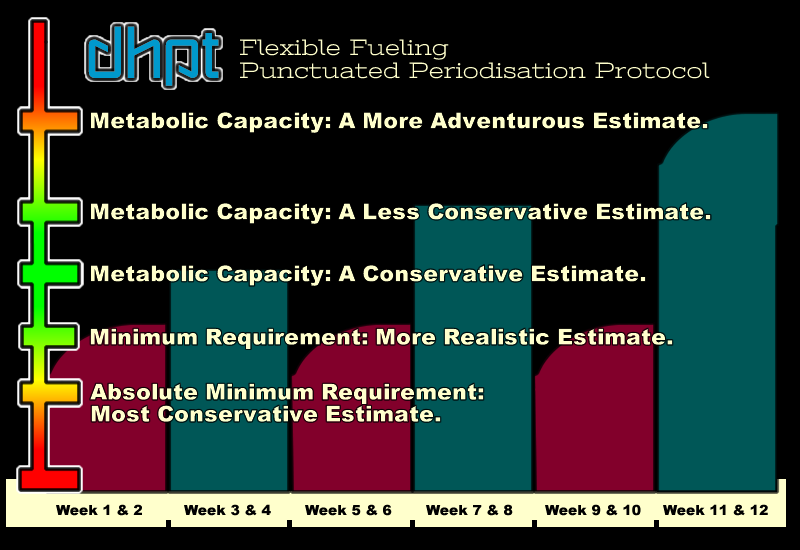
Refer to the graphic below, and I'll explain how it works.


For the first two weeks, we start at the most conservative estimate of absolute minimum requirement. Often this is still more than the amounts people are attempting to work with when they come to me. I drew this as a curve, as we're likely to find that it does in fact turn out to be overly conservative and that we need to come a little higher, towards a more reasonable, more workable reflection of our minimum requirement.

For the next two weeks, we work to a conservative estimate of Metabolic Capacity.

In theory vs in practice.

In theory, so long as you're in caloric deficit your body will draw upon fat stores to make up the difference, right? And the further into deficit, the more fat loss, right? And if you're not seeing fat loss, you're not in deficit, right?

Bull. Shit.

Real quick... what a lot of these fucking imbeciles out there don't quite have the brain capacity to grasp is that there is a difference between for example a 90kg male aspiring body builder who has just done a "bulk" on say 3500 cals per day, and a female athlete on 1400 calories per day or an overweight mature age female with a decades long history of extreme crash dieting. The male could cut to 2500 calories and see fat loss due to being "in deficit" and may find at some point that he needs to cut further to keep leaning out. That's not how I'd do it because I'm smarter than that, but that's why they think "if you're in deficit you lose fat, when you're not losing fat cut further into deficit". The female athlete can't possibly cut any lower and should never have been instructed to cut that low to begin with, YOU GET ME?

So, in pursuit of your goals you need more than just "restrict, restrict further and keep on restricting indefinitely until you hate your fucken life". You need a system where you work to intelligently calculated targets, and assess your response to those targets until you find what feels right and works right for you, allowing you to enjoy life and enjoy your best and most sustainable results from training.

Assessing the response and revising the strategy.

In theory you should see fat loss and therefore weight loss in that two week period at minimal intake. Interestingly though, some people will not see weight loss at that phase, but will see fat loss during the next two weeks while working to higher intakes. In which case, the question is whether the period of restriction is unproductive or whether it is necessary as the fat loss is a response to coming out of deficit. There's only one way to find out. If the period of restriction proves unproductive then it makes sense to find the lowest productive level of intake and consider that the new minimum.

If there is no fat loss at either level, you may decide to repeat the period and give it a little longer to see if it kicks in. Or you may logically conclude that since you can't go any lower, and since a conservative estimate of the most you could benefit from didn't do the job, you can only conclude that intake is still not high enough and a further increase to a less conservative estimate is required, as indicated on the chart at Week 7 & 8. In fact... if fat loss is apparent I'd still be likely to conclude that our conservative estimate is indeed quite conservative and I'd be optimistic that an increase to a less conservative level will prove productive.

At the very worst if we do overshoot that maximum level of intake and see an increase in weight beyond what would be explained simply by having more food passing through the digestive system, we have two weeks back at minimal intakes just around the corner that will resolve that, and we know to set our higher target more conservatively next time.

More likely though especially in the younger, the taller, and especially the more active people with a higher level of athletic prowess, everything works out better than expected and by the third cycle of the strategy we're confident and enthusiastic to get more adventurous with our higher targets.

Beyond Twelve Weeks

Having worked to different levels we'll have learned what's the least we can expect to last a few days or a week on, what's the most we can currently put to use while producing a leaner condition, and what's the optimal level of fueling relative to our requirements. We can then make an educated decision how best to proceed, either eating intuitively in accordance with our new habits and the healthy appetite we've developed, or by working to an optimal target for an extended period, or by continuing with the Punctuated Periodisation Protocol.
It's about enjoying life, enjoying the intellectual stimulation of working to a strategy, enjoying the physical stimulation of training, and enjoying the best and most sustainable results in athletic performance and condition.

Of course... such a complex and convoluted approach is not for everyone, which is why Flexible Fueling works on a spectrum between the "towards intuitive" to the "towards capacity" approaches, with this being somewhere in between. And it goes without saying that there's only ONE person capable of coaching this approach. Other people calling themselves "IIFYM" or "Flexible Dieting" guys and girls can't even begin to grasp this stuff. They literally just think "keep eating less, you must be lying to me and eating more than you say you are" is what passes for coaching.

Update:

Here's the revised version of the graphic representation of the strategy.

Now, exactly how this plays out is likely to vary from each individual to the next, but road testing this myself and with some clients what I've found is that at a certain point (week 9 on this version of the graphic) you realise that while you could reduce back down to those conservative, minimal intake targets, it's not actually doing you any favours to do so. So rather than cut back to minimal, you merely reduce from "less conservative" back to "conservative".

Also I've added a column for Week 13 & 14, where having established where our true maximal level aka metabolic capacity is, we have a good feel for an optimal level which is just shy of maximum, where we maintain absolute best performance and condition indefinitely.
Share:

Sponsor & Support My Blog

Labels

Popular Posts